- Karnak is the world’s largest ancient religious complex, covering more than 100 hectares on Luxor’s East Bank; it dwarfs almost every other monument in Egypt.
- Allow at least 2–3 hours for the highlights; a full morning gives you time to explore without rushing, including the often-overlooked Open-Air Museum.
- October to April offers the most comfortable visiting temperatures; arriving at opening time means you explore before the main tour groups arrive.
- An evening Sound and Light Show (running several nights a week) narrates the temple’s history through dramatic coloured projections on the columns and pylons.
- Most travellers pair Karnak with nearby Luxor Temple in a single day, often as part of a structured Luxor tour combining the East and West Banks.
Egypt Tour Packages: 5 to 11 Days (5–11 days): Per person from $650 · private and small-group itineraries with hotels, guides and transfers.
Why Karnak Belongs on Every Egypt Itinerary
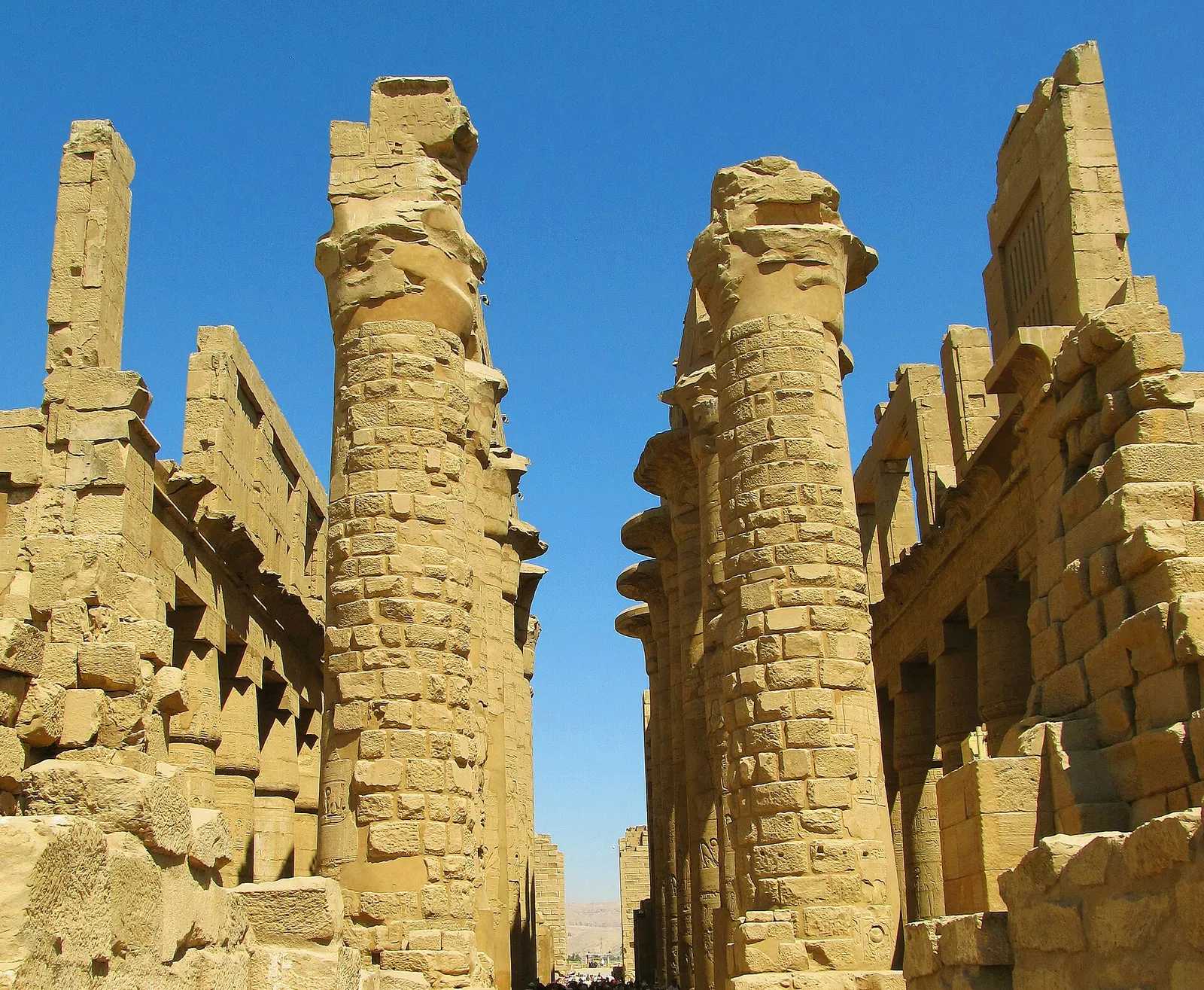
There is a moment, just inside the First Pylon of Karnak Temple, when the sheer scale of the place stops you in your tracks. Ahead stretches the Great Hypostyle Hall: 134 massive columns, the tallest rising 21 metres, packed so densely that you can lose a companion within seconds. Beyond it lie courtyards, pylons, chapels, obelisks, a sacred lake, and an open-air museum, all enclosed within a mudbrick enclosure wall thick enough to drive a car along. It is not so much a temple as an ancient city, and it is the most visited monument in Egypt outside of Cairo.
Built, expanded, and embellished over roughly 2,000 years by more than 30 different pharaohs, Karnak was the spiritual heart of the New Kingdom; the seat of Amun-Ra, king of the gods, and the source of enormous priestly wealth and political power. Today it is a UNESCO World Heritage Site and the undisputed centrepiece of any serious Luxor sightseeing itinerary. If you see only one monument in Upper Egypt, let it be this one.
A Brief History: Two Millennia of Royal Ambition
The site’s origins stretch back to the Middle Kingdom, around 2055 BCE, when a modest shrine to Amun was erected on a low rise above the Nile’s floodplain. It was the New Kingdom pharaohs (Thutmose I, Hatshepsut, Thutmose III, Seti I, and Ramesses II among them) who transformed that humble precinct into the colossal complex we see today. Each ruler added pylons, halls, and statuary to outshine their predecessors, funding the work with the enormous revenues flowing from Egypt’s imperial conquests.
At its peak, the Precinct of Amun-Ra: the largest and most visited of Karnak’s three main precincts, employed tens of thousands of priests, craftsmen, farmers, and administrators. Construction continued through the Late Period and well into Ptolemaic times, meaning that pharaohs from dynasties as diverse as the 18th and the 30th all left their mark here. Walking through Karnak is, in this sense, a compressed survey of Egyptian history: if you know where to look, you can trace two thousand years of artistic and theological evolution in a single afternoon.
The Key Monuments: What to See Inside the Complex
Given Karnak’s size, arriving with a clear sense of priorities makes the difference between a memorable visit and an overwhelming one. The following highlights are non-negotiable.
The Great Hypostyle Hall is the undisputed centrepiece, a forest of columns decorated with reliefs that still retain traces of their original paint. The central processional aisle is flanked by twelve papyrus-capital columns, each nearly three metres in diameter; the outer rows of smaller columns stretch away into a dusty, cathedral-like gloom. Set aside at least 30 minutes here alone, and look up: the painted ceiling survives in several sections.
The Obelisks of Hatshepsut stand just beyond the hall. Two were originally erected; one survives to its full height of roughly 29 metres, its apex once sheathed in electrum. The female pharaoh Hatshepsut raised them in just seven months, a feat of logistics that impresses even by modern standards.
The Sacred Lake, in the south-eastern corner of the precinct, is one of the most peaceful spots on the entire site. Priests purified themselves here before rituals, and a colossal granite scarab nearby is said to bring good fortune to those who walk around it seven times, a cheerful tradition faithfully observed by visitors of every nationality.
On the way out, look for the Avenue of Ram-Headed Sphinxes that once linked Karnak to Luxor Temple, roughly three kilometres to the south. The full avenue was recently restored and opens for evening strolls, offering one of the most atmospheric walks in Egypt. Finally, the small Open-Air Museum: accessed through a separate entrance within the complex, houses reconstructed chapels and a fine collection of painted limestone blocks. It is frequently overlooked by hurried visitors, which means you may have it almost entirely to yourself.
When to Visit: Seasons and Timing at a Glance
Timing your visit correctly can make an enormous difference to your experience. Karnak is one of Egypt’s most popular monuments, and midday crowds in peak season can be substantial. The table below compares the main travel windows to help you plan.
| Season | Months | Temperature | Crowds | Verdict |
|---|---|---|---|---|
| High Season | Oct – Feb | Mild (20–28 °C) | Busy, especially Dec–Jan | Best weather; book tours well in advance |
| Shoulder Season | Mar – Apr / Sep | Warm (25–35 °C) | Moderate | Good balance of comfort and flexibility |
| Low Season | May – Aug | Very hot (35–45 °C) | Light | Feasible early morning only; not ideal for first-time visitors |
Whatever the season, aim to arrive when the gates open. The site is quietest in the first two hours of the morning and again in the late afternoon. Midday (when coach tours converge) is consistently the most crowded and hottest window, and best avoided.
Wear comfortable, closed-toe shoes, the stone floors are uneven and the complex is large. Loose, lightweight clothing that covers shoulders and knees is both respectful and practical in the heat. Bring a refillable water bottle; there are vendors inside, but arriving well hydrated is sensible. Hats and sunscreen are essential from March onwards. A knowledgeable Egyptologist guide will make sense of the reliefs, explain the political stories carved into the pylons, and help you prioritise what to see, most visitors who experience Karnak both with and without a guide say the guided experience is dramatically richer.
The Evening Sound and Light Show
Once the day visitors have left and the stones cool in the desert evening, Karnak undergoes a remarkable transformation. The Sound and Light Show: one of the oldest and most polished of Egypt’s outdoor spectaculars, leads groups along a narrated route through the darkened complex, with pylons, columns, and the Sacred Lake illuminated by coloured projections and theatrical lighting.
The narration traces Karnak’s history from its mythological origins through the great pharaohs of the New Kingdom, with shows available in multiple languages across different evenings of the week. The reflections on the Sacred Lake, the shadows pooling between the Hypostyle Hall columns, and the sudden illumination of the obelisks against a deep desert sky create an atmosphere that no daylight photograph can capture. Many travellers who have already visited Karnak by day describe the evening show as the highlight of their entire stay in Luxor.
Show schedules and available languages rotate seasonally. Your tour operator or hotel can advise on current timings; or simply get in touch with our team below and we will arrange everything for you.
Ready to Explore Luxor with a Local Expert?
Our Luxor specialists arrange private guided visits to Karnak, Luxor Temple, the Valley of the Kings, and beyond, tailored to your pace, your interests, and your travel dates. Reach out and we will build your perfect Upper Egypt itinerary from scratch.
Getting to Karnak and Making the Most of Luxor
Karnak Temple sits on the East Bank of the Nile, roughly 2.5 kilometres north of Luxor city centre. From the centre, you can reach it by taxi, calèche (horse-drawn carriage), bicycle, or on foot along the Corniche; the riverside promenade is especially pleasant in the early morning, with river views that set the mood for the day ahead.
If you are arriving from Aswan or travelling on a Nile cruise, your vessel will dock on the East Bank and Karnak will be within easy reach. Travellers combining Luxor with Aswan: a pairing that every Egyptophile should make; will find that arranging private transport between the two cities is straightforward, whether by train, private car, or as part of a multi-day Egypt package.
The West Bank of Luxor, home to the Valley of the Kings, Hatshepsut’s mortuary temple at Deir el-Bahari, and the Colossi of Memnon: is a short public ferry ride across the river and merits a full, separate day. The standard structure for a Luxor visit is one day on the East Bank (Karnak and Luxor Temple) and one day on the West Bank, though devoted history enthusiasts regularly stretch this to three days. For itinerary ideas that combine Luxor and Aswan seamlessly, visit our Aswan tours page.
Egypt Tour Packages: 5 to 11 Days
Per person from $650 · private and small-group itineraries with hotels, guides and transfers. Real local operator in Alexandria, message us with your dates and group size for an exact quote.
- Discover Egypt: 11 Days All-Inclusive: Adults from $1725
- Classic Egypt: 10 Days Tour: Adults from $1550
Frequently Asked Questions
Most visitors spend 2–3 hours at Karnak. A thorough visit covering the Hypostyle Hall, the obelisks, the Sacred Lake, and the Open-Air Museum comfortably fills a full morning. If you are travelling with children or prefer a gentler pace, allow extra time for rest stops in the shade between areas.
Early morning (arriving at or shortly after opening) gives you the best light for photography, the coolest temperatures, and the fewest crowds. Late afternoon is a reasonable second choice. Midday, particularly from March to October, brings both peak heat and peak congestion and is best avoided if you have any flexibility.
Yes; the site is fully open to independent visitors and many travellers explore on their own. That said, Karnak’s history is dense and the complex is genuinely labyrinthine; a knowledgeable Egyptologist guide transforms what can feel like a bewildering maze into a coherent, dramatic narrative. Most visitors who experience the site both with and without a guide say the guided experience is significantly richer.
Absolutely, and most Egyptologists would argue that Karnak is the more architecturally complex site of the two. The Pyramids represent the engineering brilliance of the Old Kingdom; Karnak shows the full flowering of New Kingdom religious art, ritual architecture, and political inscription. They complement each other beautifully, and any comprehensive Egypt itinerary should include both. Contact our team to see how we can combine Cairo and Luxor into a single, seamless journey.