Valley of the Kings, Queens, Hatshepsut & Colossi (6 hours): Adults from $80 · Children (6-11): $35.
Why Luxor’s West Bank Rewards the Curious Traveller
Most visitors to Luxor arrive with a single obsession: the Valley of the Kings. And who could blame them? The gilded burial chambers of Tutankhamun and the vast hypogeum of Seti I are genuinely breathtaking. Yet the west bank of the Nile at Luxor is a landscape of extraordinary archaeological depth, stretching for kilometres and concealing temples, artisans’ villages and painted sanctuaries that see only a fraction of the traffic pouring into that famous valley. If you have ever stood in the car park at the Valley of the Kings and wished for somewhere quieter, somewhere just as magnificent, Luxor’s west bank beyond the Valley of the Kings is exactly where to look. This guide introduces the sites that reward explorers willing to venture a little further.
Medinet Habu – Luxor’s Most Underrated Monument
At the southern end of the west bank necropolis stands Medinet Habu, the mortuary temple of Ramesses III, and it may be the best-preserved large temple in all of Egypt. Where the Valley of the Kings draws coachloads of visitors every morning, Medinet Habu often feels almost peaceful. The towering pylons are covered in vivid relief carvings recording the pharaoh’s military campaigns against the Sea Peoples, one of the ancient world’s most dramatic naval confrontations, rendered in meticulous stone. Walk through the Migdol Tower, a massive gateway modelled on a Syrian fortress, and you enter a sequence of columned courts where traces of the original polychrome paint still cling stubbornly to the hieroglyphs. The complex originally encompassed a royal palace, administrative quarters and a sacred lake, and its scale dwarfs every expectation. Few experiences on the Luxor circuit are as quietly astonishing as standing alone in Medinet Habu’s innermost sanctuary at first light, listening to nothing but birdsong. For anyone with an interest in New Kingdom Egypt, this temple alone justifies the journey to Luxor.
The Ramesseum and the Colossi of Memnon
A short drive north of Medinet Habu lies the Ramesseum, the mortuary temple of Ramesses II. It is here (or rather, from an ancient description of a colossal statue on this site) that Percy Bysshe Shelley drew inspiration for his famous sonnet Ozymandias. The fallen granite colossus that prompted the poem still lies face-up amid the sand: once estimated to have stood some 17 metres tall and weighed close to a thousand tonnes, it is broken and half-buried today, yet the implied scale of the original is staggering. The remaining columns of the hypostyle hall give a vivid sense of the temple’s former grandeur; with the roof long gone, swallows nest in the carved capitals and the light shifts colour through the afternoon. The Ramesseum is far less visited than the nearby royal valleys and rewards a slow, contemplative wander.
Before crossing to the west bank from Luxor town, most visitors stop briefly at the Colossi of Memnon: two enormous seated figures of Amenhotep III that stand guard on the plain, all that remain above ground of what was once the largest mortuary temple in Thebes. The stop is brief and the statues are as commanding in person as in any photograph.
Deir el-Medina – The Village That Built the Royal Tombs
Deir el-Medina is one of the most remarkable archaeological sites in the world, and it remains genuinely undervisited. This was the walled village of the craftsmen and artists who spent their careers cutting and decorating the royal tombs. Because many of its residents were literate (extraordinary by the standards of the ancient world) thousands of personal texts survive: work rosters, complaints about unpaid wages, records of strikes, love poems and everyday shopping lists. Deir el-Medina gives us the most complete picture we have of ordinary daily life in pharaonic Egypt.
The site includes the partially standing remains of the village houses, a small Ptolemaic temple dedicated to Hathor and Maat, and a group of artisans’ tombs whose interiors rival anything in the Valley of the Kings for quality of painting. The tomb of Sennedjem is particularly celebrated: its walls depict the Fields of Aaru (the Egyptian vision of paradise) as a luminous world of harvests, blue-green water and golden light, and the colours have remained startling across more than three millennia.
Close by, the Valley of the Queens contains the tomb of Queen Nefertari, wife of Ramesses II, whose paintings are considered among the finest in all of Egypt. Entry to Nefertari’s tomb is capped at a small number of visitors each day, so it is strongly advisable to arrange your ticket in advance through Ahmose Travel to avoid disappointment.
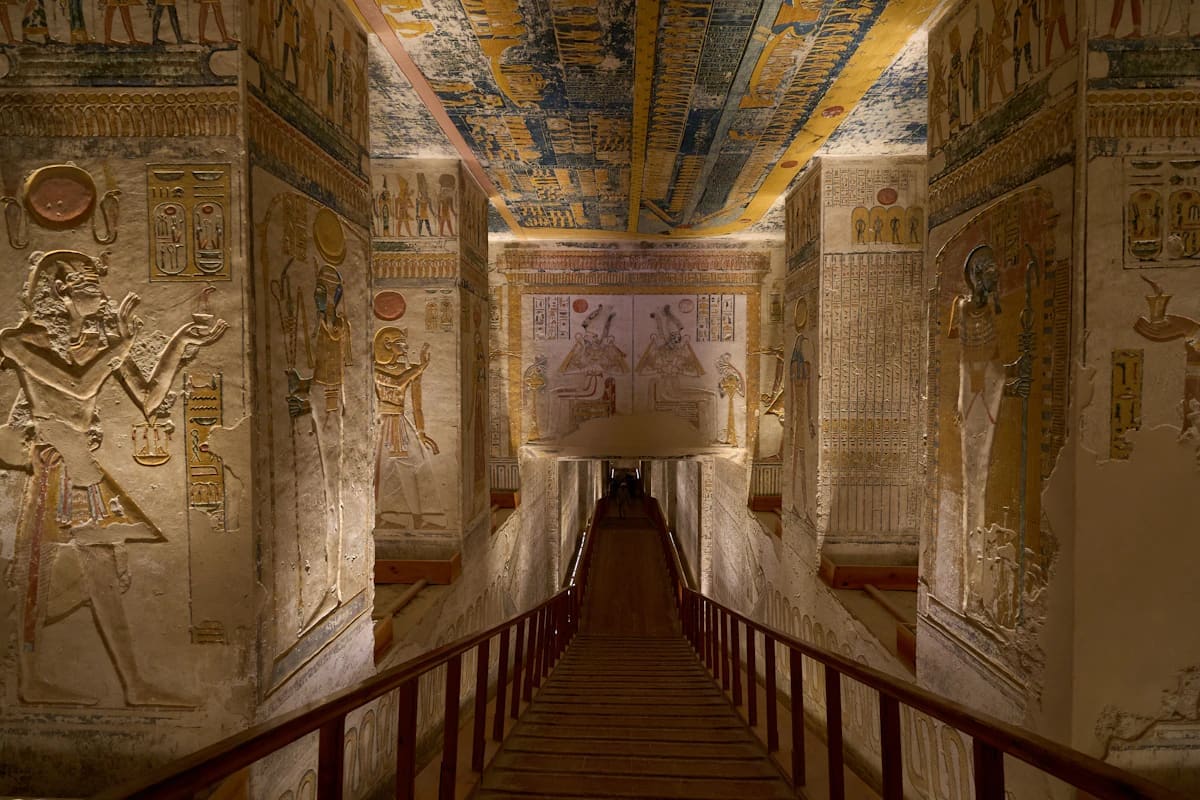
The Nobles’ Tombs – Ancient Egypt in Living Colour
Scattered across the limestone hillside between the Valley of the Kings and the plain below are hundreds of private burial chapels belonging to the courtiers, scribes, priests and officials who served the New Kingdom pharaohs. These are the Tombs of the Nobles, and they offer something the royal tombs do not: intimate images of everyday life, rendered with warmth and extraordinary specificity. Hunting in the marshes. Banquets with musicians and dancing girls. Farmers harvesting wheat, vintners treading grapes, cattle being driven across slow-moving canals. The human scale of these paintings is deeply affecting, and the colour in the finest tombs, particularly in the necropolis of Sheikh Abd el-Qurna: is so vivid that it seems almost impossible to believe these are 3,000-year-old pigments applied to plaster.
Standout visits include the tomb of Nakht, justly famous for its banquet scenes and a celebrated trio of female musicians; the tomb of Menna, whose agricultural scenes are of exceptional quality and detail; and the tomb of Sennofer, widely known as the Tomb of the Vineyards because its entire ceiling is painted to resemble a leafy grape arbour arching overhead. The Nobles’ Tombs are ticketed in small clusters at modest cost and even in peak season attract only a fraction of the visitors queuing for the Valley of the Kings.
| Site | Typical Crowds | Defining Feature | Often Missed? |
|---|---|---|---|
| Valley of the Kings | Very High | Royal tombs; Tutankhamun’s KV62 | No |
| Medinet Habu | Low – Moderate | Vast coloured reliefs; Migdol Tower | Yes |
| Ramesseum | Low | Fallen colossus; open-sky hypostyle hall | Yes |
| Deir el-Medina | Low – Moderate | Craftsmen’s village; Sennedjem’s tomb | Yes |
| Nobles’ Tombs | Low | Vivid everyday-life paintings | Yes |
| Valley of the Queens | Moderate | Nefertari’s tomb (strictly limited tickets) | Partly |
Ready to Explore Luxor’s Hidden West Bank?
Ahmose Travel’s expert Egyptologist guides know which sites to visit in which order, how to avoid the midday crush, and which tombs most tour groups walk straight past. Get in touch and let us design your perfect Luxor day, or a full Upper Egypt itinerary built around what matters most to you.
Planning Your West Bank Day: Practical Essentials
The west bank of Luxor is easily reached from the east bank by public ferry or private boat, and the sites are accessible by taxi, microbus or with a private guide and vehicle. Entry tickets for each site or cluster of sites are purchased at the main west bank ticket office near the Colossi of Memnon; it is worth deciding your programme in advance so you do not make unnecessary trips back to the booth. The Valley of the Kings standard ticket grants access to three royal tombs; certain premium tombs including KV62 require an additional ticket purchased separately.
The finest times to visit are in the early morning when the sites first open and the air is cool, or in the late afternoon when crowds have thinned and the light turns golden on the limestone cliffs. Midday on the west bank plateau can be fierce, particularly from May to September. A relaxed full day allows you to cover the Valley of the Kings, Hatshepsut’s Temple at Deir el-Bahari, and at least two further sites comfortably. If you are combining Luxor with the rest of Egypt, perhaps a Nile cruise continuing south to Aswan: speak to us about an itinerary that gives this extraordinary landscape the time it genuinely deserves.
Wear light, breathable clothing and bring considerably more water than you think you will need, the west bank plateau is exposed and hot even in spring. Comfortable, closed-toe shoes are essential as paths are uneven and sandy. A small torch (flashlight) is useful in the darker inner chambers of certain tombs. Photography is permitted at most sites but restricted in a few specific tombs; check the notice at each entrance before raising your camera. If you plan to visit Nefertari’s tomb in the Valley of the Queens, arrange your ticket well in advance, daily numbers are strictly capped and tickets sell out quickly during high season, which runs broadly from October through April.
Combining the West Bank with Wider Luxor Exploration
Luxor’s west bank does not exist in isolation. The east bank holds extraordinary riches of its own Karnak Temple, the largest religious complex ever constructed, and Luxor Temple, which glows warm amber under evening floodlights and rewards a visit at both sunrise and dusk. A well-planned trip gives at least two days to each bank, with unhurried time in between to sit by the river, watch the feluccas and absorb the remarkable density of history that surrounds you in this city.
Luxor also serves as the classic starting or finishing point for a Nile cruise south towards Aswan, passing temples at Esna, Edfu and Kom Ombo that most day-trippers never see. Whatever combination suits your interests and your schedule, the depth of experience on offer here is genuinely unmatched anywhere in the world. Browse further inspiration across our travel blog, or speak to us directly about putting your Egypt journey together.
Whatever else you include in your Egyptian travels, give Luxor’s west bank beyond the Valley of the Kings more than a rushed morning. It is one of the greatest open-air museums on earth, and the best of it waits quietly for the travellers with the curiosity to look a little further.
Valley of the Kings, Queens, Hatshepsut & Colossi
Adults from $80 · Children (6-11): $35. Real local operator in Alexandria, message us with your dates and group size for an exact quote.
- Luxor Hot Air Balloon at Sunrise: Adults from $145
- Discover Egypt: 11 Days All-Inclusive: Adults from $1725
Frequently Asked Questions
Luxor’s west bank contains a remarkable range of ancient sites beyond the famous valley: Medinet Habu (the mortuary temple of Ramesses III), the Ramesseum, the Colossi of Memnon, Hatshepsut’s Temple at Deir el-Bahari, the Valley of the Queens, the craftsmen’s village of Deir el-Medina, and the extensive Nobles’ Tombs necropolis. Many of these sites receive far fewer visitors than the Valley of the Kings yet are equally (and sometimes more) impressive.
A single full day is enough to cover the Valley of the Kings, Hatshepsut’s Temple, and one or two additional stops. To visit Medinet Habu, the Nobles’ Tombs and Deir el-Medina at a genuinely relaxed pace, plan a second west bank day focused on the southern sites. Most travellers who allow two full days describe it as one of the highlights of their entire trip to Egypt.
A guide is not compulsory, but the west bank richly rewards expert explanation. Understanding the iconography, mythology and human stories behind the carvings transforms a walk among ruins into something genuinely moving. An Egyptologist guide also knows how to organise the day to avoid peak crowds, which tombs are open on a given day, and where the lesser-known chambers offer the most extraordinary painting.
It is possible to combine all three in one long day, but it makes for a rushed and tiring schedule. A better approach is to visit the Valley of the Kings and Hatshepsut’s Temple on day one, then dedicate a second morning to Medinet Habu, Deir el-Medina and the Nobles’ Tombs when you can move at an unhurried pace and genuinely appreciate what you are seeing. Get in touch and we will help design the best itinerary for the time you have.